
From Waterfall to Agile and Beyond
From Waterfall to Agile and Beyond
Exploring the Evolution of Software Development Methodologies
Oct 8, 2026 · @Nagesh
Introduction
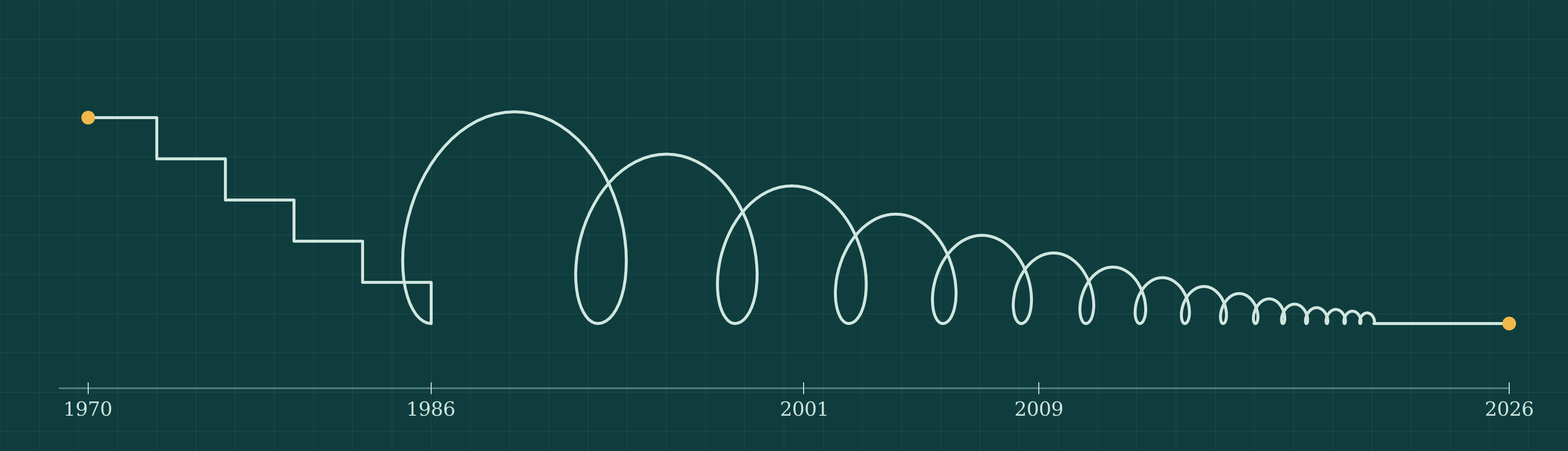
Every software methodology is a bet about where uncertainty lives and how expensive it is to change course. Waterfall bet that requirements could be fixed early and change was costly. Agile bet the opposite. DevOps and what followed bet that the cost of change could be engineered down toward zero.
For a technical team, methodology is not a process poster on the wall. It decides when code gets tested, who talks to whom, how often you deploy, and how much rework a late requirement causes. Understanding why each approach emerged makes it easier to pick the right mix instead of following one by habit.
This article traces that evolution from the 1970s to today, then closes with practical guidance for choosing an approach.
Waterfall: the sequential model
Waterfall organizes work into strict phases, each finished and signed off before the next begins. It grew out of manufacturing and construction, where changing a design after the foundation is poured is ruinously expensive.
The model is usually traced to Winston Royce's 1970 paper on managing large software systems. Ironically, Royce presented the pure sequential flow as risky and recommended feedback loops and prototyping. Later readers, and standards such as the US DoD-STD-2167 (1985), adopted the simple linear version anyway.
The classic phases
Requirements gathering and specification
System and software design
Implementation
Integration and testing
Deployment
Maintenance
Where it works
Requirements are stable and well understood, such as regulatory reporting or a hardware-bound embedded system.
Contracts demand fixed scope, fixed price, and formal sign-offs.
Heavy documentation and traceability are mandatory, as in medical devices, aerospace, and defense.
Where it breaks
Testing happens late, so design defects surface when they are most expensive to fix.
Users see working software only at the end, often after their needs have shifted.
Long feedback loops hide integration risk until the integration phase, a pattern teams call "integration hell".
Progress is measured by documents produced, not by working software.
The bridge years: iterative and incremental models
Between the 1980s and late 1990s, several models kept Waterfall's discipline but added iteration to manage risk. They are worth knowing because many enterprise teams still run hybrids built on them.
V-Model
The V-Model pairs each development phase with a matching test phase: requirements with acceptance tests, architecture with system tests, design with integration tests, and code with unit tests. It was formalized in Germany as the V-Modell for government projects. Its lasting contribution is that test planning starts on day one, not after coding. It remains common in automotive and safety-critical work.
Spiral model
Barry Boehm's Spiral model (1986) structures work as repeated loops. Each loop sets objectives, analyzes and reduces risk, builds and tests, then plans the next loop. Risk, not phase completion, drives the sequence. It suits large, high-risk systems but needs strong risk-analysis skills to run well.
Rational Unified Process (RUP)
RUP, from Rational Software in the late 1990s, divides a project into four phases: Inception, Elaboration, Construction, and Transition. Each phase contains several time-boxed iterations. It was use-case driven and architecture-centric, and it popularized UML. Its weakness was weight: teams often adopted every artifact it described rather than tailoring it down.
What these models taught
Early, repeated feedback reduces risk more than more upfront analysis.
Testing should be designed alongside requirements.
Iterations need a fixed length to keep scope honest.
Agile: the 2001 turning point
In February 2001, seventeen practitioners met in Snowbird, Utah, and published the Manifesto for Agile Software Development. They were already running lightweight methods such as Scrum and Extreme Programming; the manifesto named what those methods shared.
The four values
The manifesto values the left side of each pair more than the right, while still valuing the right:
Individuals and interactions over processes and tools
Working software over comprehensive documentation
Customer collaboration over contract negotiation
Responding to change over following a plan
Twelve supporting principles follow, including frequent delivery of working software, welcoming late changes, sustainable pace, and regular team reflection.
Scrum
Scrum, presented by Ken Schwaber and Jeff Sutherland in 1995, is a framework for time-boxed delivery.
Roles: Product Owner (owns value and the backlog), Scrum Master (owns the process and removes impediments), Developers (own the increment).
Events: Sprint (usually 1 to 4 weeks), Sprint Planning, Daily Scrum, Sprint Review, Sprint Retrospective.
Artifacts: Product Backlog, Sprint Backlog, and the Increment, each tied to a commitment (Product Goal, Sprint Goal, Definition of Done).
Scrum says little about engineering practice, which is why teams often pair it with XP.
Extreme Programming (XP)
Kent Beck's XP (book published 1999) is the most engineering-focused Agile method. Its core practices include test-driven development, pair programming, continuous integration, small releases, refactoring, simple design, and collective code ownership. Many practices now treated as standard, such as CI and TDD, entered the mainstream through XP.
Kanban
Kanban for software, popularized by David J. Anderson around 2010, borrows from Toyota's production system. It has no sprints or prescribed roles.
Visualize the workflow on a board.
Limit work in progress (WIP) per column.
Manage and measure flow, using lead time and cycle time.
Improve continuously, in small evolutionary steps.
Kanban suits support, operations, and maintenance work where requests arrive unpredictably. Many teams run "Scrumban", keeping Scrum's cadence with Kanban's WIP limits.
Where Agile struggles
"Agile in name only": rituals adopted without empowered teams or real customer feedback.
Neglected architecture and documentation under the banner of "working software".
Fixed-budget, fixed-scope contracts that clash with evolving backlogs.
Lean, DevOps, and continuous delivery
Agile shortened the loop between users and developers. It left a second gap open: the handoff from development to operations. Lean thinking and DevOps closed it.
Lean software development
Mary and Tom Poppendieck's Lean Software Development (2003) translated Toyota's ideas into seven principles: eliminate waste, build quality in, create knowledge, defer commitment, deliver fast, respect people, and optimize the whole. Waste in software includes partially done work, task switching, waiting for approvals, unused features, and handoffs.
DevOps
The term DevOps took hold around 2009, when Patrick Debois organized the first DevOpsDays in Ghent. It is a culture and set of practices rather than a framework. The common summary is CALMS: Culture, Automation, Lean, Measurement, and Sharing.
Key practices include:
Continuous integration: every change merges to a shared mainline and runs an automated build and test suite.
Continuous delivery: every passing build is deployable at the push of a button, as described by Jez Humble and David Farley (2010).
Continuous deployment: every passing build goes to production automatically.
Infrastructure as code: environments are versioned and reproducible, using tools such as Terraform or CloudFormation.
Observability: logs, metrics, and traces make production behavior visible to the team that built it.
"You build it, you run it": development teams share on-call responsibility.
Measuring delivery performance
The DORA research program (Forsgren, Humble, and Kim, Accelerate, 2018) linked four metrics to organizational performance:
Metric | What it measures |
|---|---|
Deployment frequency | How often code reaches production |
Lead time for changes | Time from commit to running in production |
Change failure rate | Share of deployments that cause a failure |
Time to restore service | How quickly a failure is recovered |
The key finding: speed and stability are not trade-offs. High performers lead on all four.
Scaling Agile beyond one team
Scrum and XP were designed for a single team of roughly 5 to 10 people. Large organizations needed ways to coordinate dozens of teams on one product, and several frameworks emerged in the 2010s.
Framework | Origin | Core idea | Typical criticism |
|---|---|---|---|
SAFe (Scaled Agile Framework) | Dean Leffingwell, 2011 | Agile Release Trains of 50 to 125 people plan together in a quarterly Program Increment (PI) Planning event | Heavy and prescriptive; can recreate top-down planning with Agile labels |
LeSS (Large-Scale Scrum) | Craig Larman and Bas Vodde | One Product Owner and one backlog shared by multiple Scrum teams | Demands deep organizational change that many companies resist |
Spotify model | Henrik Kniberg and Anders Ivarsson, 2012 | Autonomous squads grouped into tribes, with chapters and guilds for shared skills | A snapshot of one company, not a framework; Spotify itself moved on from parts of it |
Disciplined Agile (DA) | Scott Ambler and Mark Lines | A toolkit of context-based choices rather than one prescribed process | Breadth makes it hard to adopt without coaching |
The lesson from a decade of scaling: coordination problems are often architecture problems. Teams that own loosely coupled services or modules need far less ceremony than teams sharing one tightly coupled codebase. This idea, Conway's Law in reverse, is central to Team Topologies (Skelton and Pais, 2019).
Beyond Agile: current directions
The newest shifts are less about meeting cadence and more about removing friction from the whole delivery system.
DevSecOps and shift-left quality
Security and quality checks move into the pipeline instead of sitting at the end. Static analysis, dependency scanning, secret detection, and automated tests run on every commit. QA shifts from a phase to a capability: testers design test strategy, build automation, and pair with developers on acceptance criteria before code is written.
Platform engineering
As teams took on "you build it, you run it", cognitive load grew. Platform engineering responds with internal developer platforms: self-service, paved paths for provisioning environments, deploying, and monitoring. The platform team treats other engineers as customers.
Product and outcome orientation
Teams are funded around long-lived products rather than temporary projects. Success is measured by outcomes such as adoption, cycle time, or error rates, not by output such as story points. Practices like feature flags, A/B testing, and trunk-based development let teams release small changes and learn from real usage.
AI-assisted development
AI coding assistants and agents now draft code, tests, documentation, and migration scripts. They compress implementation time, which moves the bottleneck to specification, review, and verification. Teams that benefit most invest in clear acceptance criteria, strong automated tests, and disciplined code review, because those are what make generated code safe to merge.
Pragmatic hybrids
Few organizations run a pure method. Common hybrids include:
Waterfall-style phase gates for budgeting and compliance, with Scrum sprints inside each phase.
Scrum for feature teams and Kanban for support and operations.
Fixed milestones for a migration cutover, with iterative delivery of the modules leading up to it.
Side-by-side comparison
The approaches differ mainly in how often they deliver, when they test, and how they absorb change.
Approach | Era | Delivery cadence | When testing happens | Handling change | Best fit |
|---|---|---|---|---|---|
Waterfall | 1970s | Once, at the end | After implementation | Formal change requests; costly | Stable, regulated, fixed-scope work |
V-Model | 1980s to 1990s | Once, at the end | Planned from the start, executed after coding | Costly | Safety-critical systems |
Spiral | 1986 | Per risk-driven loop | Every loop | Expected each loop | Large, high-risk programs |
RUP | Late 1990s | Per iteration within phases | Every iteration | Managed through iterations | Large enterprise systems |
Scrum | 1995 onward | Every sprint (1 to 4 weeks) | Within each sprint | Re-prioritized each sprint | Product development with evolving needs |
XP | 1999 onward | Small, frequent releases | Continuously (TDD) | Welcomed | Small to mid teams needing high code quality |
Kanban | 2010 onward | Continuous flow | Per work item | Any time; next pull | Support, operations, maintenance |
DevOps / CD | 2009 onward | On demand, often daily | Automated on every commit | Small changes, fast rollback | Web services, SaaS, cloud platforms |
Choosing an approach for your team
Start from the shape of the work, not from a framework's popularity. Five questions narrow the choice quickly.
How stable are the requirements? Stable and contractually fixed points toward phase gates. Evolving or discovered through use points toward iterative delivery.
How costly is a defect in production? Very high cost (safety, finance, compliance) needs V-Model-style traceability, even inside Agile sprints.
How does work arrive? Planned feature work fits Scrum. Unpredictable tickets and fixes fit Kanban.
How fast can you deploy safely? If releases take weeks of manual effort, invest in CI/CD before adding process. Automation usually returns more than another ceremony.
How coupled is the system? A tightly coupled legacy system forces cross-team coordination. Decoupling it is often the real path to agility.
Example: a legacy system migration
Migrations mix fixed and evolving work. A practical blend:
Fixed milestones for the hard constraints: data migration rehearsals, parallel-run windows, and cutover date.
Sprints for rebuilding modules, each ending with a demo to the business owners who use that module.
Kanban for defects and retest cycles, with WIP limits so QA does not become a bottleneck.
A written specification per module with confirmed requirements, open questions, and acceptance criteria, so testers and developers verify against the same definition.
Automated regression tests on the core workflows before cutover, so later changes do not silently break migrated behavior.
Warning signs of a mismatch
Sprint goals are routinely missed because requirements arrive mid-sprint.
Defects pile up at the end of each release despite "Agile" labels.
Teams spend more time in coordination meetings than in delivery.
Nobody can say when a change will reach users.
Conclusion
The evolution from Waterfall to Agile to DevOps is a steady shortening of feedback loops: from years, to weeks, to minutes. Each step responded to a real failure of the one before. Waterfall's late testing gave rise to iteration. Agile's delivery gap with operations gave rise to DevOps. DevOps' cognitive load gave rise to platform engineering.
No methodology is universally right. The strongest teams treat these approaches as a toolbox, and keep three habits regardless of the label:
Get working software in front of real users early and often.
Make quality and testing part of every change, not a phase.
Inspect how the team works, and change it when the evidence says so.
As AI tools take over more of the typing, those habits matter more, not less. The scarce skills become defining the right problem, specifying it clearly, and verifying the result.

'%20d='M34.017,41.99l-20,0.019c-4.4,0.004-8.003-3.592-8.008-7.992l-0.019-20%20c-0.004-4.4,3.592-8.003,7.992-8.008l20-0.019c4.4-0.004,8.003,3.592,8.008,7.992l0.019,20%20C42.014,38.383,38.417,41.986,34.017,41.99z'/%3e%3cradialGradient%20id='yOrnnhliCrdS2gy~4tD8mb'%20cx='11.786'%20cy='5.54'%20r='29.813'%20gradientTransform='matrix(1%200%200%20.6663%200%201.849)'%20gradientUnits='userSpaceOnUse'%3e%3cstop%20offset='0'%20stop-color='%234168c9'/%3e%3cstop%20offset='.999'%20stop-color='%234168c9'%20stop-opacity='0'/%3e%3c/radialGradient%3e%3cpath%20fill='url(%23yOrnnhliCrdS2gy~4tD8mb)'%20d='M34.017,41.99l-20,0.019c-4.4,0.004-8.003-3.592-8.008-7.992l-0.019-20%20c-0.004-4.4,3.592-8.003,7.992-8.008l20-0.019c4.4-0.004,8.003,3.592,8.008,7.992l0.019,20%20C42.014,38.383,38.417,41.986,34.017,41.99z'/%3e%3cpath%20fill='%23fff'%20d='M24,31c-3.859,0-7-3.14-7-7s3.141-7,7-7s7,3.14,7,7S27.859,31,24,31z%20M24,19c-2.757,0-5,2.243-5,5%20s2.243,5,5,5s5-2.243,5-5S26.757,19,24,19z'/%3e%3ccircle%20cx='31.5'%20cy='16.5'%20r='1.5'%20fill='%23fff'/%3e%3cpath%20fill='%23fff'%20d='M30,37H18c-3.859,0-7-3.14-7-7V18c0-3.86,3.141-7,7-7h12c3.859,0,7,3.14,7,7v12%20C37,33.86,33.859,37,30,37z%20M18,13c-2.757,0-5,2.243-5,5v12c0,2.757,2.243,5,5,5h12c2.757,0,5-2.243,5-5V18c0-2.757-2.243-5-5-5H18z'/%3e%3c/svg%3e)

